How AI Reshapes Interaction in Multilingual Families
Application submitted · Decision pending
LEGO Foundation Fellowship · Proposed research
Status as of October 26, 2026.
Illustrative scenario from the proposal
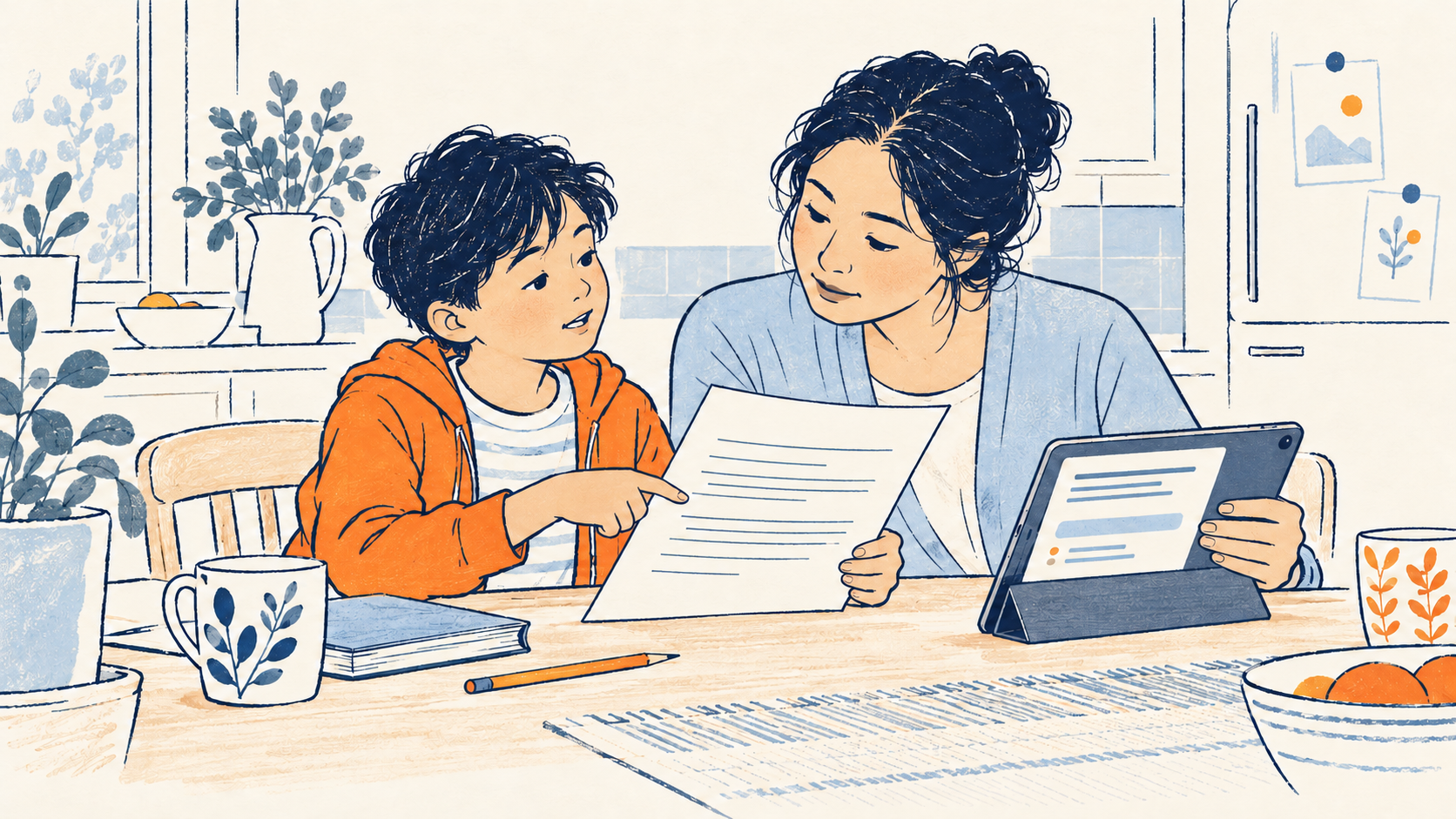
Consider a multilingual family gathered around the kitchen table with an English-language message from school. Without AI, the child might translate the message while the caregiver asks questions, clarifies its meaning, and connects it to what the family already knows. With generative AI, the caregiver can obtain a fluent translation and explanation without relying on the child. This may relieve the child of a responsibility that can be burdensome and give the caregiver more direct access to school information. But it may also remove the child from a conversation in which the child’s language knowledge once mattered. This tension extends beyond school messages to homework, shared reading, and online inquiry: does AI open new questions across languages, or does it replace the slower conversation through which children and caregivers learn from one another? As families decide when to use AI, when to turn to one another, and how to evaluate the answers they receive, they are also renegotiating who explains, who decides, whose language carries authority, and whose knowledge is recognized. This project examines when these shifts support or constrain children’s agency, their connections with caregivers, and their multilingual belonging, understood as the sense that their languages and ways of knowing are valued.
The proposed study examines how children and caregivers evaluate AI-generated responses and negotiate participation and authority. It attends to decisions to use, question, refuse, or defer AI, treating those decisions as part of family interaction.
Longitudinal interactional ethnography will follow recurring activities such as shared reading, homework, storytelling, and family inquiry. Close analysis of interaction over time will examine how families work with multilingual resources and make sense of AI together.
What an AI system produces is only part of the encounter. How family members interpret a response, bring other knowledge to bear, and decide what to do next matters for shared inquiry. The project aims to inform resources that support multilingual participation and productive struggle in family learning.
This direction extends my research on multilingual families' meaning-making in museums into family life with generative AI. It retains a focus on talk, gesture, shared attention, and the material and textual resources through which people learn together.
Email Min-Seok