Four strands, one question
How do people, and the institutions around them, learn to see competence?
Multilingual Family Literacy in Science Museums
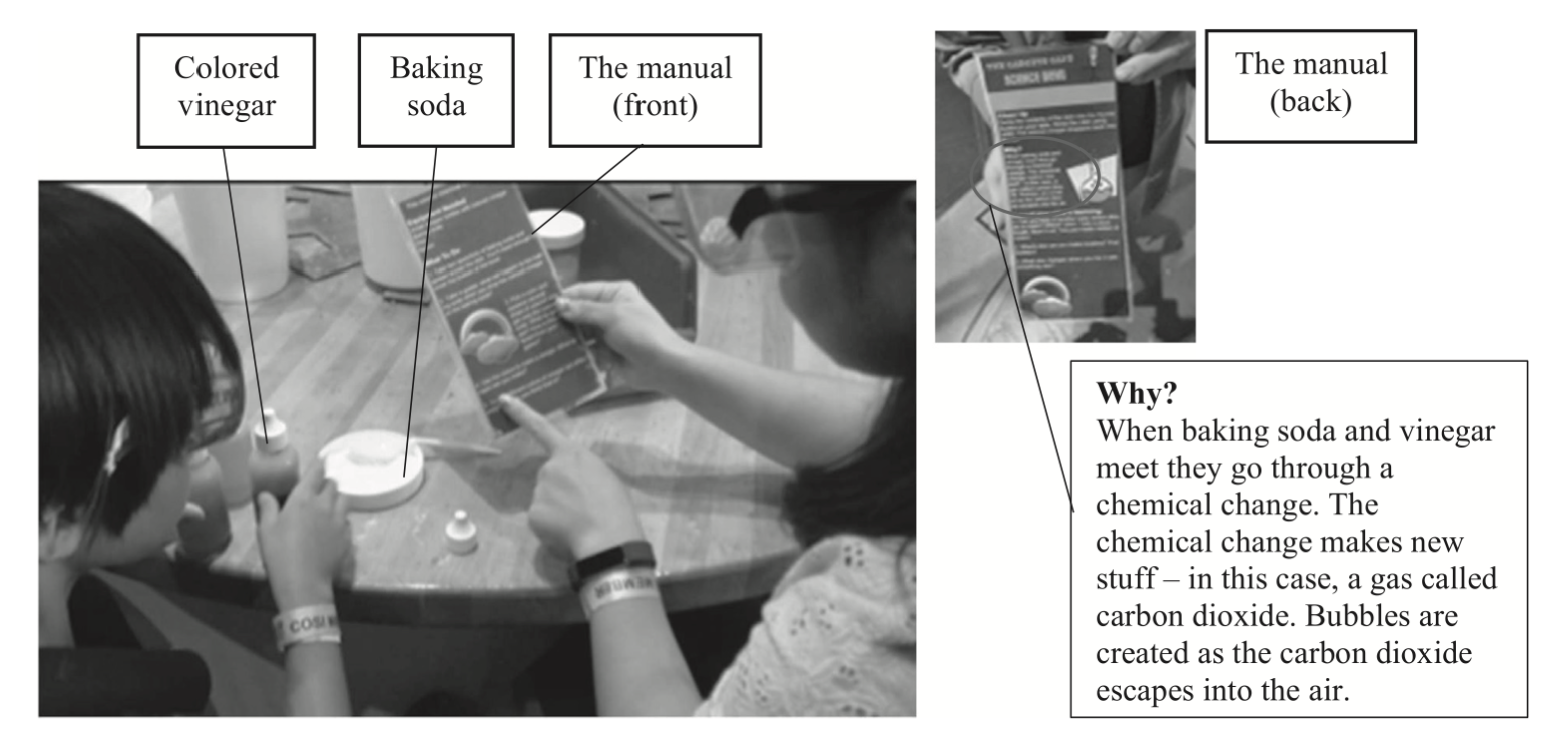
This program began my research. In a series of video-based, ethnographic studies, I followed sojourning Korean-English families as they made sense of exhibits in a public science museum. Rather than treating literacy as the decoding of print, I examined how families drew on their full semiotic repertoire, their talk, gesture, gaze, objects, and the museum's own labels and instructions, to reason together.
Two patterns recur across cases. Families translanguage fluidly, layering translations to fit a child's reasoning, reworking a label's wording into successive and more precise options. And institutional texts do more than inform: signage, instructions, and exhibit scripts quietly gate participation and define what counts as literate competence. Reading is often positioned as the sanctioned way into an exhibit, while families' multilingual sense-making goes unrecorded.
The takeaway that drives the rest of my work is that competence is an observable, interactional achievement, and that the artifacts coordinating participation are redesignable. This museum research is the empirical foundation for much of my published scholarship.
Read the project story →Professional Vision in the Architecture Design Studio
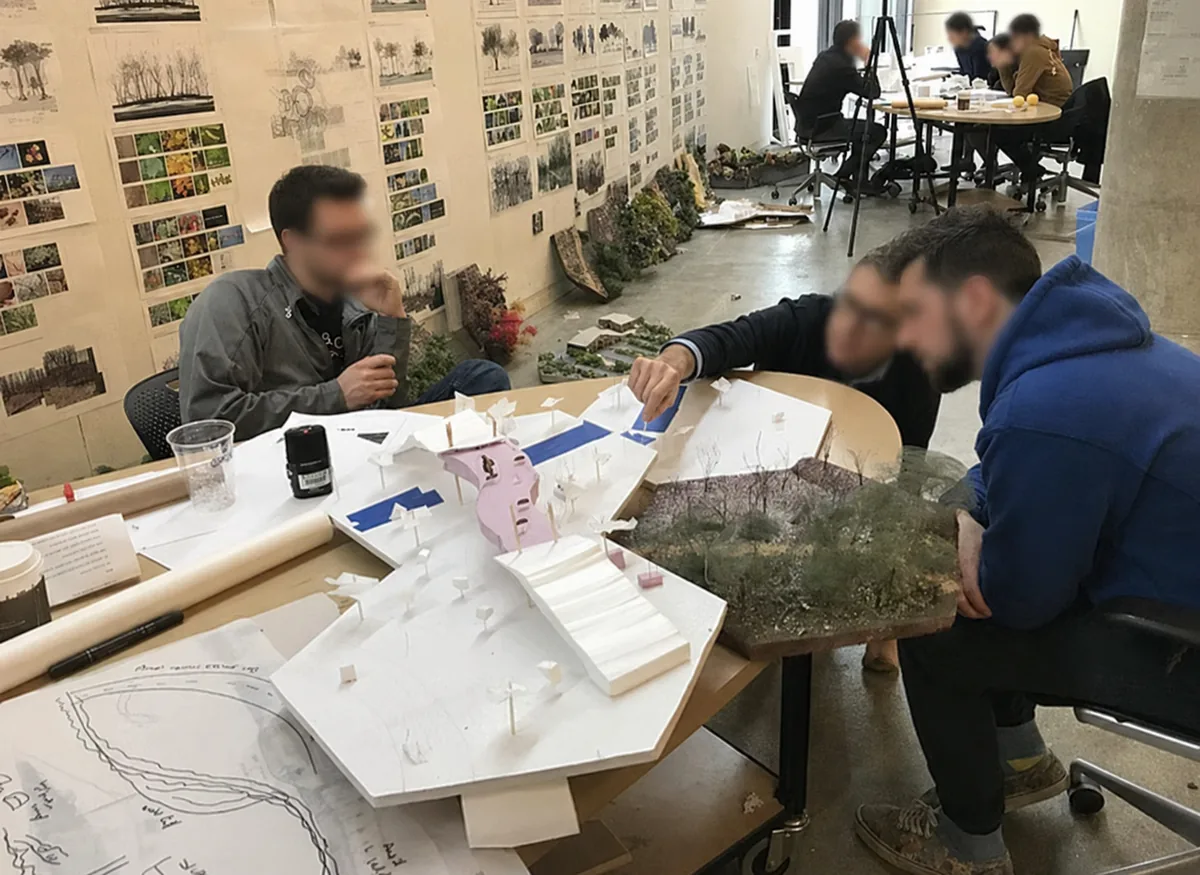
In a landscape architecture studio, I study how students, many of them multilingual and international, learn to see and talk like designers. The central site is the desk critique, where an instructor and a student work together over a physical model. Using fine-grained multimodal transcription, I trace how talk, gesture, gaze, and the model itself coordinate to build shared design narratives.
The analysis treats professional vision as an interactional accomplishment rather than a private skill. Students do not simply receive feedback; through pointing, shaping gestures, and shifts of gaze, they author design stories and rehearse imagined movement through space, a biker descending a slope, a pedestrian crossing a path. Instructors' advice-giving opens room for this authoring, and disciplinary ways of seeing laminate across time and imagined scenarios.
This strand extends the concept of professional vision to second-language disciplinary socialization, and it is the methodological home of my interaction-analytic work.
Read the project story →Family Learning Observation & Analysis (FLOA)
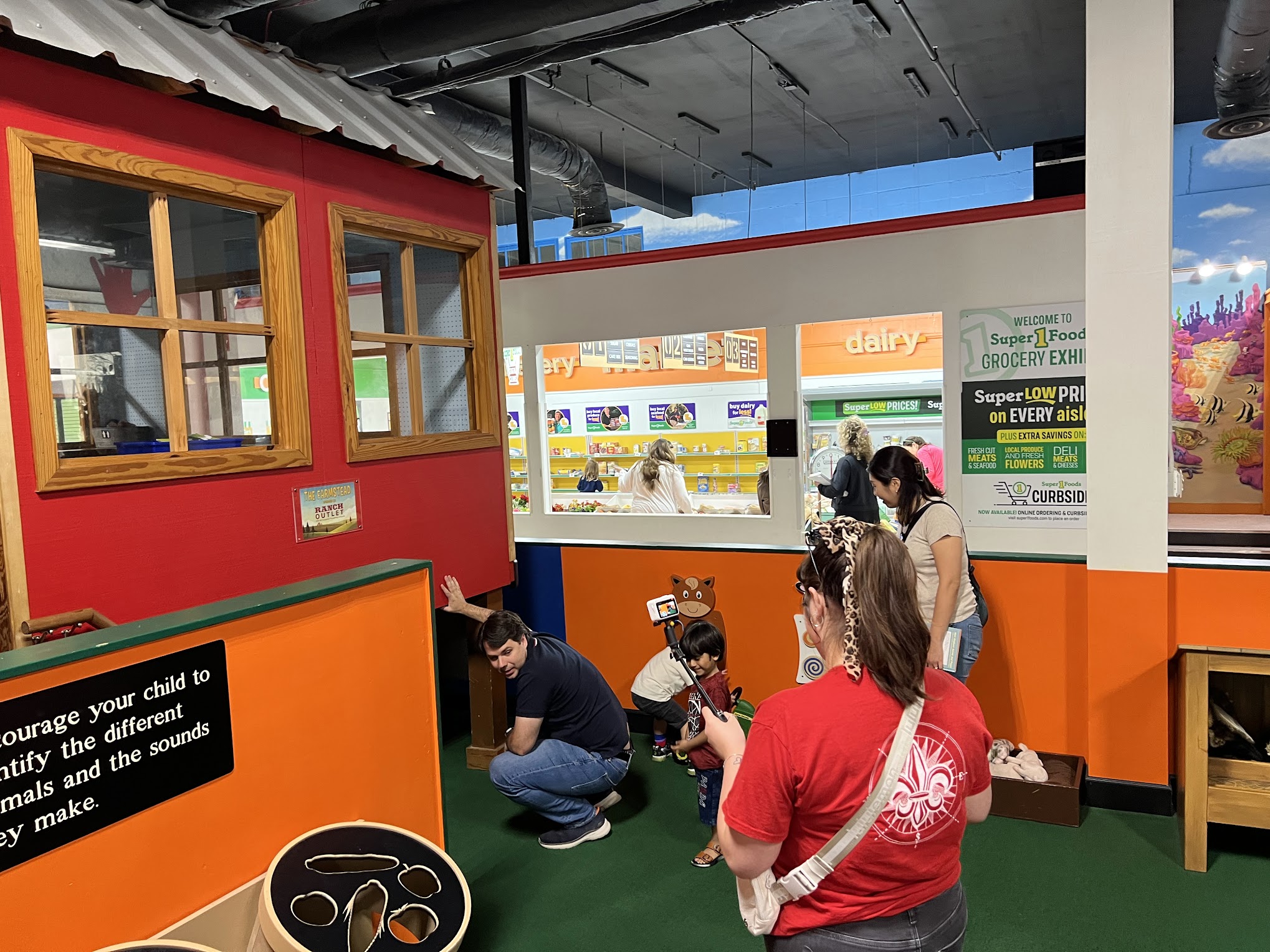
FLOA is a structured training cycle, Observe, Analyze, Reflect, Plan, that I built into literacy methods courses. Its purpose is to slow down interpretation so that preservice teachers replace deficit assumptions with evidence-based noticing of what multilingual families actually do.
Working from video cases and a fieldnote protocol, candidates learn to broaden literacy beyond print to multimodal participation, and to move families' linguistic practices from the background to central evidence of children's meaning-making. The work also names a stubborn limit: even after noticing multilingual competence, candidates often default to English-only lesson plans. That pattern reveals raciolinguistic ideologies as a design problem in teacher learning, not simply an attitude to be corrected.
FLOA connects my family-learning research to teacher education, and it is the apparatus I am now adapting to train noticing in library and museum staff.
Read the project story →Professional Vision in Library Storytime
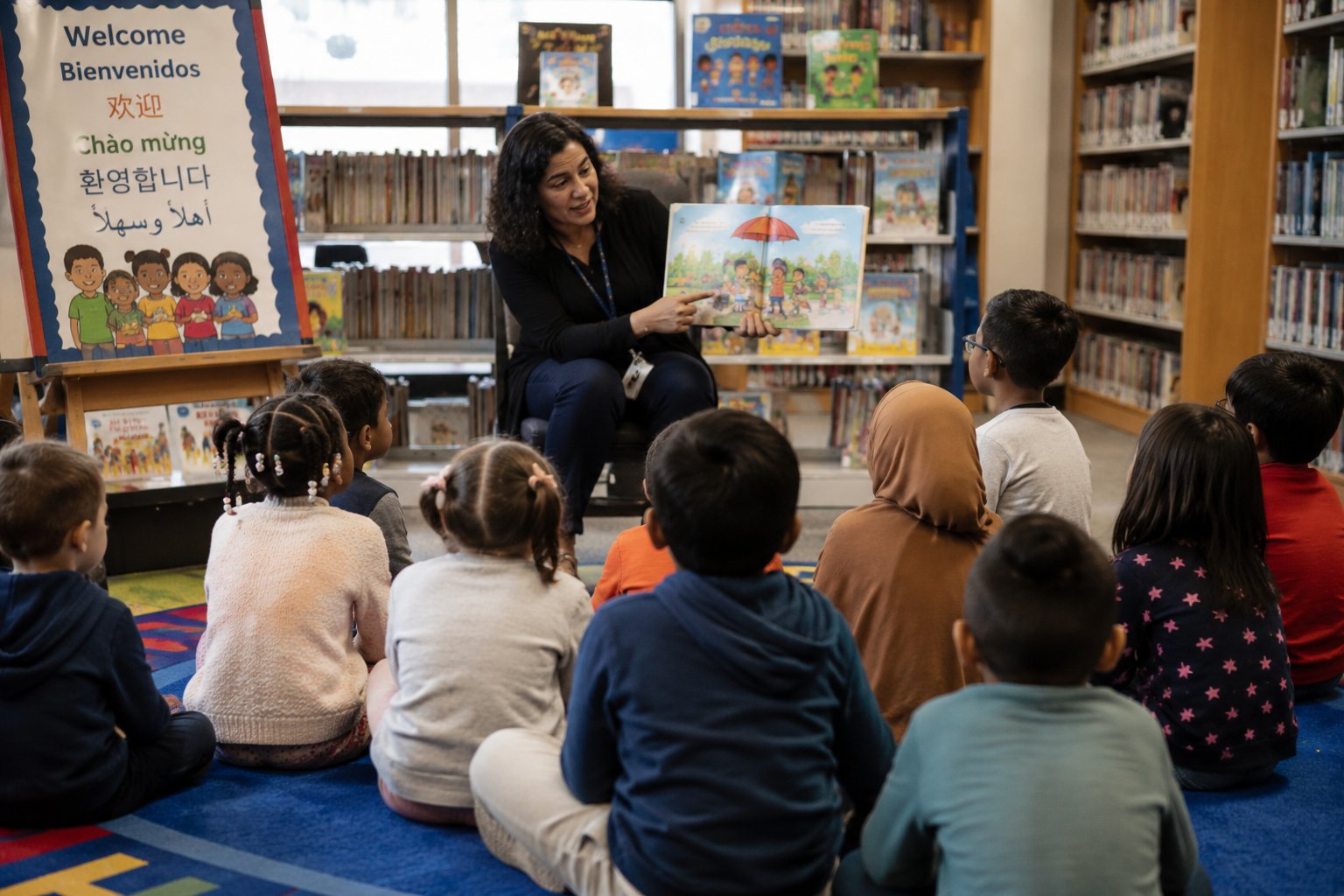
This is the forward direction of my program at the iSchool. I am extending professional vision from classrooms and museums into public libraries, with storytime as the anchoring site. The questions are how multilingual families participate in storytime and library spaces, what institutional texts and program scripts make noticeable or invisible, and how staff can be trained to see family competence as evidence.
The design is comparative. Two nearby libraries serve overlapping but distinct multilingual communities through different infrastructures, which lets me ask how institutional arrangements shape what competence becomes legible. The method carries over from my earlier work: multimodal interaction analysis of naturally occurring programs, a shared video corpus and annotation workflow, and FLOA-derived noticing routines adapted for library staff. The aim is not only to document participation but to redesign storytime and public programs as equitable, built-in access.
I am positioning this work for IMLS and Spencer funding and for collaboration across campus, including the Center for Children's Books, the CU Community Fab Lab, and local public libraries.
Methodological Approach
My unit of analysis is moment-to-moment participation. Using multimodal interaction analysis and microethnographic discourse analysis of video, I trace how talk, gesture, gaze, objects, and institutional texts coordinate what participants can do next, and what becomes recordable as evidence of competence.
Fine-grained video analysis of this kind remains uncommon in library and information science, where it offers a distinct way to make multilingual family learning legible to institutions.