During an architecture desk critique, a student traced the movement of a path through the air with her pen. The gesture lasted only a few seconds.
Yet in that brief gesture, she was doing more than describing a model. She was making design visible. She was showing how a future user might move through space, how a landscape might be experienced, and how an architectural idea could be seen.
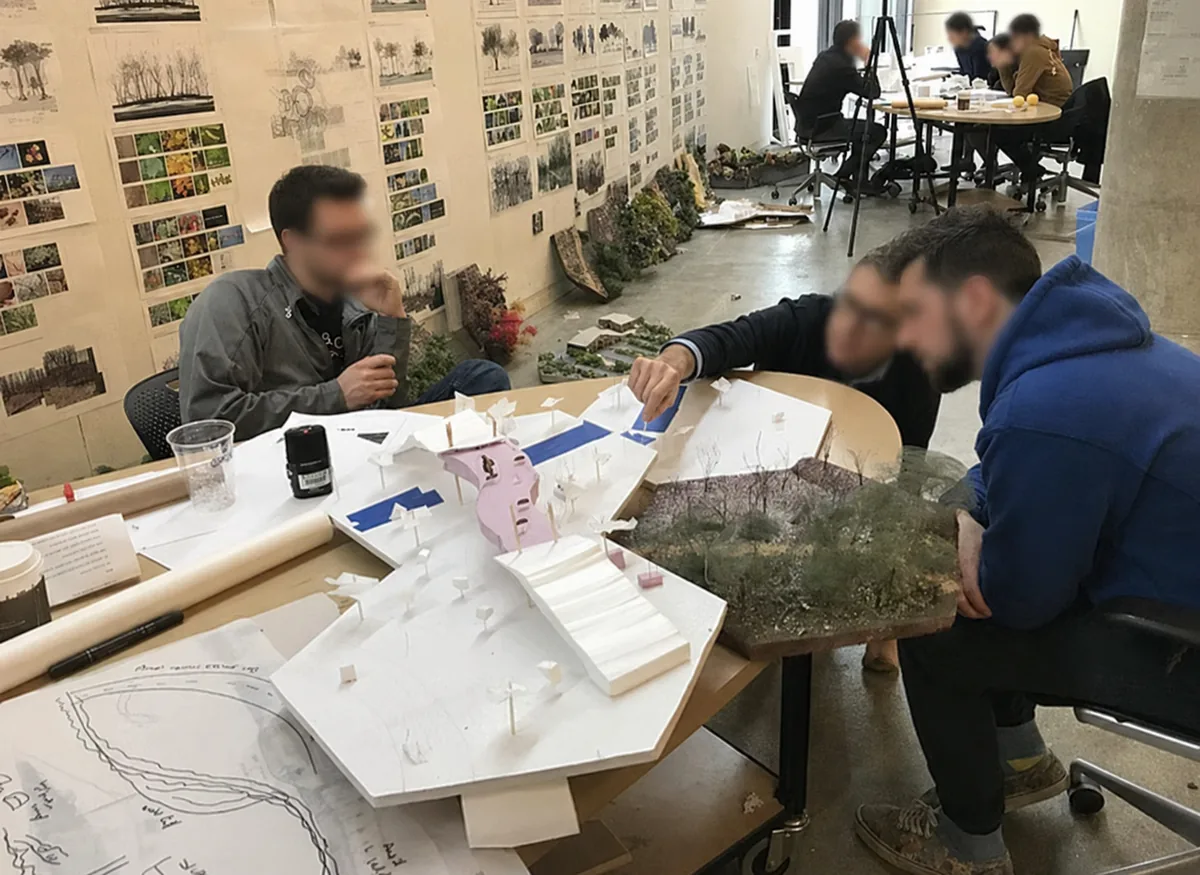
A design studio critique where students learn to see, describe, and evaluate space through interaction.
That moment led me to ask:
How do people learn to see like professionals?
In the architecture studio, learning is not only about acquiring vocabulary or mastering technical concepts. It is also about learning how to notice, describe, gesture toward, and evaluate spatial possibilities in ways that become recognizable within a profession.
Through interactional analysis of desk critiques, I found that professional vision develops through repeated participation in disciplinary conversations. Students learn how to point, trace, compare, reframe, and narrate design decisions.
The studio critique becomes a place where language, gesture, drawings, models, and bodies work together. What students learn is not just how to design, but how to make design visible to others.
This project helped me think more broadly about professional vision across institutions. Whether in architecture studios, teacher education, museums, or libraries, learning often depends on what people are trained to notice.
The architecture project taught me that professional ways of seeing are not abstract. They are built interaction by interaction, through talk, gesture, objects, and shared attention.
This work now informs my broader research on how educators, librarians, and other professionals learn to recognize forms of competence that might otherwise remain invisible.